Predicción del deterioro de las funciones ejecutivas en adultos jóvenes utilizando aprendizaje automático y datos de estilo de vida
DOI:
https://doi.org/10.17488/RMIB.47.1.1550Palabras clave:
Evaluación neuropsicológica, Predicción de deterioro cognitive, Aprendizaje automáticoResumen
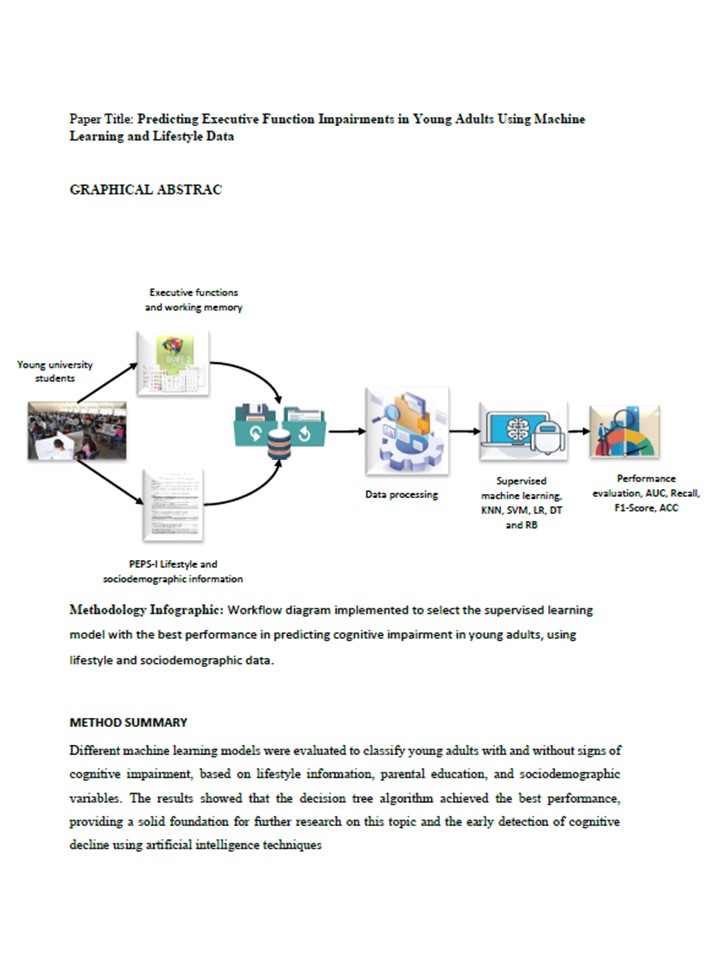
El desarrollo de deterioros en las funciones ejecutivas (FE) en jóvenes, como dificultades en la atención, la memoria y la resolución de problemas, está influenciado por factores biológicos, sociales y de estilo de vida. Sin embargo, la investigación sobre la predicción de estos deterioros sigue siendo limitada debido a la falta de herramientas confiables. Este estudio analizó a 90 estudiantes universitarios mediante pruebas de FE y cuestionarios sobre estilo de vida y factores sociodemográficos. Se evaluaron cinco modelos de aprendizaje automático: Árboles de Decisión (DT), k-Nearest Neighbors (KNN), Máquinas de Soporte Vectorial (SVM), Regresión Logística (LR) y Bosques Aleatorios (RF), aplicando validación cruzada para la evaluación de los modelos. Los resultados indicaron una incidencia del 62% en deterioros de las FE. Se identificaron la educación materna y la nutrición como factores clave influyentes. Entre los modelos, DT obtuvo el mejor desempeño, con una sensibilidad del 61.9%, un F1-score de 62.1% y un AUC de 66.54%, mientras que RF tuvo el peor rendimiento. Las limitaciones incluyen la naturaleza transversal de los datos, lo que restringe la inferencia causal, y la dependencia de respuestas autoinformadas por los participantes, lo que podría afectar la fiabilidad de los datos. A pesar de esto, el estudio demuestra la viabilidad del uso de aprendizaje automático para predecir deterioros en las FE con datos sociodemográficos y de estilo de vida fácilmente recopilables. Las variables sociodemográficas y de estilo de vida son valiosos predictores de deterioros en las FE en jóvenes. Las herramientas de aprendizaje automático ofrecen un enfoque práctico para evaluar la salud de las FE a nivel poblacional utilizando datos accesibles.
Descargas
Citas
P. Anderson, “Assessment and development of executive function (ef) during childhood”, Child neuropsychology, vol. 8, no. 2, 2002, doi: https://doi.org/10.1076/chin.8.2.71.8724
J.R. Best and P.H. Miller, “A developmental perspective on executive function”, Child development, vol. 81, no. 6, 15 Nov. 2010, doi: https://doi.org/10.1111/j.1467-8624.2010.01499.x
A. Diamond, “Executive functions”, Annual review of psychology, vol. 64, no. 1, January 2013, doi: https://doi.org/10.1146/annurev-psych-113011-143750
C. Blair and C.C. Raver, “School readiness and self-regulation: A developmental psychobiological approach”, Annual review of psychology, vol. 66, no. 1, January 2015, doi: https://doi.org/10.1146/annurev-psych-010814-015221
S.J. Blakemore and S. Choudhury, “Development of the adolescent brain: implications for executive function and social cognition”, Journal of child psychology and psychiatry, vol. 47, no. 3-4, May 2006, doi: https://doi.org/10.1111/j.1469-7610.2006.01611.x
A.G. Gutiérrez-García and M. Landeros-Velázquez, “Evaluación de funciones ejecutivas en estudiantes universitarios con niveles de autoeficacia percibida baja”, Revista Electrónica de Psicología Iztacala, vol. 20, no. 2, June 2017.
J. Flores, F. Ostrosky and A. Lozano,” Banfe-2 bateria neuropsicológica de funciones ejecutivas y lóbulos frontales. méxico: Manual moderno”, 2014.
F.S. Mogollón García, L.D. Becerra Rojas and J.S. Adolfo Ancajima Mauriola, “Estilos de vida saludables en estudiantes de pregrado”, Conrado, vol. 16, no. 75, July 2020. Available: http://scielo.sld.cu/scielo.php?script=sci_arttext&pid=S1990-86442020000400069&lng=es&tlng=es
Y.E. Salazar-Granizo, C. Hueso-Montoro and R.A. Caparros-Gonzalez, “Lifestyles and Academic Stress in University Students of Health Sciences: A Mixed-Methodology Study”, Healthcare, vol. 12, no. 1, January 2024, doi: https://doi.org/10.3390/healthcare12141384
J.R. Best, P.H. Miller and J.A. Naglieri, “Relations between executive function and academic achievement from ages 5 to 17 in a large, representative national sample”, Learning and individual differences, vol. 21, no. 4, August 2011, doi: https://doi.org/10.1016/j.lindif.2011.01.007
A. Diamond and D.S. Ling, “Conclusions about interventions, programs, and approaches for improving executive functions that appear justified and those that, despite much hype, do not”, Developmental cognitive neuroscience, vol. 18, no. 1, April 2016, doi: https://doi.org/10.1016/j.dcn.2015.11.005
N. Zhu, D.R. Jacobs, K. Meyer, K. He, L. Launer, J. Reis, K. Yaffe, S. Sidney, R. Whitmer and L. Steffen, “Cognitive function in a middle aged cohort is related to higher quality dietary pattern 5 and 25 years earlier: the cardia study”, The journal of nutrition, health & aging, vol. 19, no. 1, 2015, doi: https://doi.org/10.1007/s12603-014-0491-7
E.E. Bron, M. Smits, W.M. Van Der Flier, H. Vrenken, F. Barkhof, P. Scheltens, J.M. Papma, R.M. Steketee, C.M. Orellana, R. Meijboom, et al., “Standardized evaluation of algorithms for computer-aided diagnosis of dementia based on structural mri: the caddementia challenge”, NeuroImage, vol. 111, no. 1, 2015, doi: https://doi.org/10.1016/j.neuroimage.2015.01.048
C. Simfukwe, S.S. A. An and Y.C. Youn, “Comparison of machine learning algorithms for predicting cognitive impairment using neuropsychological tests”, Applied Neuropsychology: Adult, vol. 1, no. 1, Sep. 2024, doi: https://doi.org/10.1080/23279095.2024.2392282
M.F. Jojoa-Acosta, S. Signo-Miguel, M.B. Garcia-Zapirain, M. Gimeno-Santos, A. Méndez-Zorrilla, C.J. Vaidya, M. Molins-Sauri, M. Guerra-Balic and O. Bruna-Rabassa, “Executive functioning in adults with down syndrome: machine-learning-based prediction of inhibitory capacity”, International Journal of Environmental Research and Public Health, vol. 18, no. 20, sep. 2021, doi: https://doi.org/10.3390/ijerph182010785
K. Modi, I. Singh, Y. Kumar, “A comprehensive analysis of artificial intelligence techniques for the prediction and prognosis of lifestyle diseases”, Archives of Computational Methods in Engineering, vol. 30, no. 8, june 2023, doi: https://doi.org/10.1007/s11831-023-09957-2
L. Zhang, S. Zhao, W. Yang, Z. Yang, Z. Wu, H. Zheng, M. Lei, “Utilizing machine learning techniques to identify severe sleep disturbances in chinese adolescents: an analysis of lifestyle, physical activity, and psychological factors”, Frontiers in Psychiatry, vol. 15, nov. 2024, doi: https://doi.org/10.3389/fpsyt.2024.1447281
Z. John Lu, “The elements of statistical learning: data mining, inference, and prediction”, Journal of the Royal Statistical Society Series A: Statistics in Society, vol. 173, no. 3, june 2010, doi: https://doi.org/10.1111/j.1467-985X.2010.00646_6.x
S. Gornale, S. Kumar, R. Siddalingappa, P.S, “ Hiremath, Survey on handwritten signature biometric data analysis for assessment of neurological disorder using machine learning techniques”, Transactions on Machine Learning and Artificial Intelligence, vol. 10, no. 2, April 2022, doi: https://doi.org/10.14738/tmlai.102.12210
S. Swati, M. Kumar, S. Namasudra, “Early prediction of cognitive impairments using physiological signal for enhanced socioeconomic status”, Information Processing & Management, vol. 59, no. 2, March 2022, doi: https://doi.org/10.1016/j.ipm.2021.102845
J. Hou, H. Jiang, Y. Han, R. Huang, X. Gao, W. Feng, Z. Guo, “Lifestyle influence on mild cognitive impairment progression: A decision tree prediction model study”, Neuropsychiatric Disease and Treatment, vol. 20, no. 1, Feb. 2024, doi: https://doi.org/10.2147/NDT.S435464
D.W. Hosmer Jr, S. Lemeshow, R.X, Sturdivant, Applied logistic regression, 3rd ed. USA: John Wiley & Sons, pp. 35.
L. Breiman, “Random forests”, Machine learning, vol. 45, no. 1, Jan. 2001, doi: https://doi.org/10.1023/A:1010933404324
D.M. Powers, “Evaluation: from precision, recall and f-measure to roc, informedness, markedness and correlation”, International Journal of Machine Learning Technology, vol 2, no. 1, Jan. 2001, doi: https://doi.org/10.48550/arXiv.2010.16061
G.W. Evans, P. Kim, “Childhood poverty, chronic stress, self-regulation, and coping”, Child development perspectives, vol. 7, no. 1, Nov. 2013, doi: https://doi.org/10.1111/cdep.12013
P.E. Davis-Kean, “The influence of parent education and family income on child achievement: the indirect role of parental expectations and the home environment”, Journal of family psychology, vol. 19, no. 2, Sep. 2005, doi: https://doi.org/10.1037/0893-3200.19.2.294
P. Glewwe, E.A. Miguel, “The impact of child health and nutrition on education in less developed countries” Handbook of development economics, vol. 4, 2007, doi: https://doi.org/10.1016/S1573-4471(07)04056-9
UNESCO, Global Education Monitoring Report 2019: Migration, Displacement and Education-Building Bridges, Not Walls ,UN, Mexico, 2018. Accessed: Feb. 25, 2025. [Online]. Available: https://hdl.handle.net/20.500.12799/6023
K.Y.C. Cuellar, G.I. Díaz, R.A. Ortíz, N.M. Pérez, J.G. Ariza, “Genealogías culturales e historias de familia en oaxaca: Diseño epistémico, estrategia metodológica y reflexividad”, Estudios sobre las culturas contemporáneas, vol. 20, no. 40, 2014. Accessed: Dec. 12, 2024. [Online]. Available: https://dialnet.unirioja.es/servlet/articulo?codigo=4990957
J.R. Ocaña-Noriega, G.S. Sagñay-Llinin, “La malnutrición y su relación en el desarrollo cognitivo en niños de la primera infancia”, Polo del conocimiento, vol. 5, No. 12, Sep. 2020, doi: https://doi.org/0000-0002-7819-9115
J.A. Cardona Murillo, F.Z. Leidy Andrea, “Influencia de la alimentación en el desarrollo cognitivo de los estudiantes en el grado de transición de la institución educativa Luis Carlos Galán Sarmiento del municipio de Carepa”, Corporación Universitaria Minuto de Dios, Urabá, Antioquia, Colombia, 2021. [Online]. Available: https://repository.uniminuto.edu/items/9c2b881d-8efc-4eee-941b-3901a995d529
J. Bernal, “Resiliencia, infancia y nutrición: propuesta de indicadores para medición en niños y adolescentes”, Revista Salud Bosque, vol. 7, no. 2, Feb. 2017, doi: https://doi.org/10.18270/rsb.v7i2.2192
P. Zaninotto, G.D. Batty, M. Allerhand, I.J. Deary, “Cognitive function trajectories and their determinants in older people: 8 years of follow-up in the English longitudinal study of ageing”, J Epidemiol Community Health, vol. 72, no. 8, Aug. 2018, doi: https://doi.org/10.1136/jech-2017-210116
G.R. Poudel, A. Barnett, M. Akram, E. Martino, L.D. Knibbs, K.J. Anstey, J.E. Shaw, E. Cerin, “Machine learning for prediction of cognitive health in adults using sociodemographic, neighbourhood environmental, and lifestyle factors”, Inter- national Journal of Environmental Research and Public Health, vol. 19, no. 17, 2022, doi: https://doi.org/10.3390/ijerph191710977
Descargas
Publicado
Cómo citar
Número
Sección
Licencia
Derechos de autor 2026 Revista Mexicana de Ingenieria Biomedica

Esta obra está bajo una licencia internacional Creative Commons Atribución-NoComercial 4.0.
Una vez que el artículo es aceptado para su publicación en la RMIB, se les solicitará al autor principal o de correspondencia que revisen y firman las cartas de cesión de derechos correspondientes para llevar a cabo la autorización para la publicación del artículo. En dicho documento se autoriza a la RMIB a publicar, en cualquier medio sin limitaciones y sin ningún costo. Los autores pueden reutilizar partes del artículo en otros documentos y reproducir parte o la totalidad para su uso personal siempre que se haga referencia bibliográfica al RMIB. No obstante, todo tipo de publicación fuera de las publicaciones académicas del autor correspondiente o para otro tipo de trabajos derivados y publicados necesitaran de un permiso escrito de la RMIB.