Evaluation of Classification Methods for EEG Signals in Older Adults for Right-Hand Motor Imagery Movements
Evaluación de Métodos de Clasificación de Señales EEG de Adultos Mayores para Movimientos Imaginados de la Mano Derecha
DOI:
https://doi.org/10.17488/RMIB.47.2.1564Keywords:
Older adults, BCI, classification, EEG, motor imageryAbstract
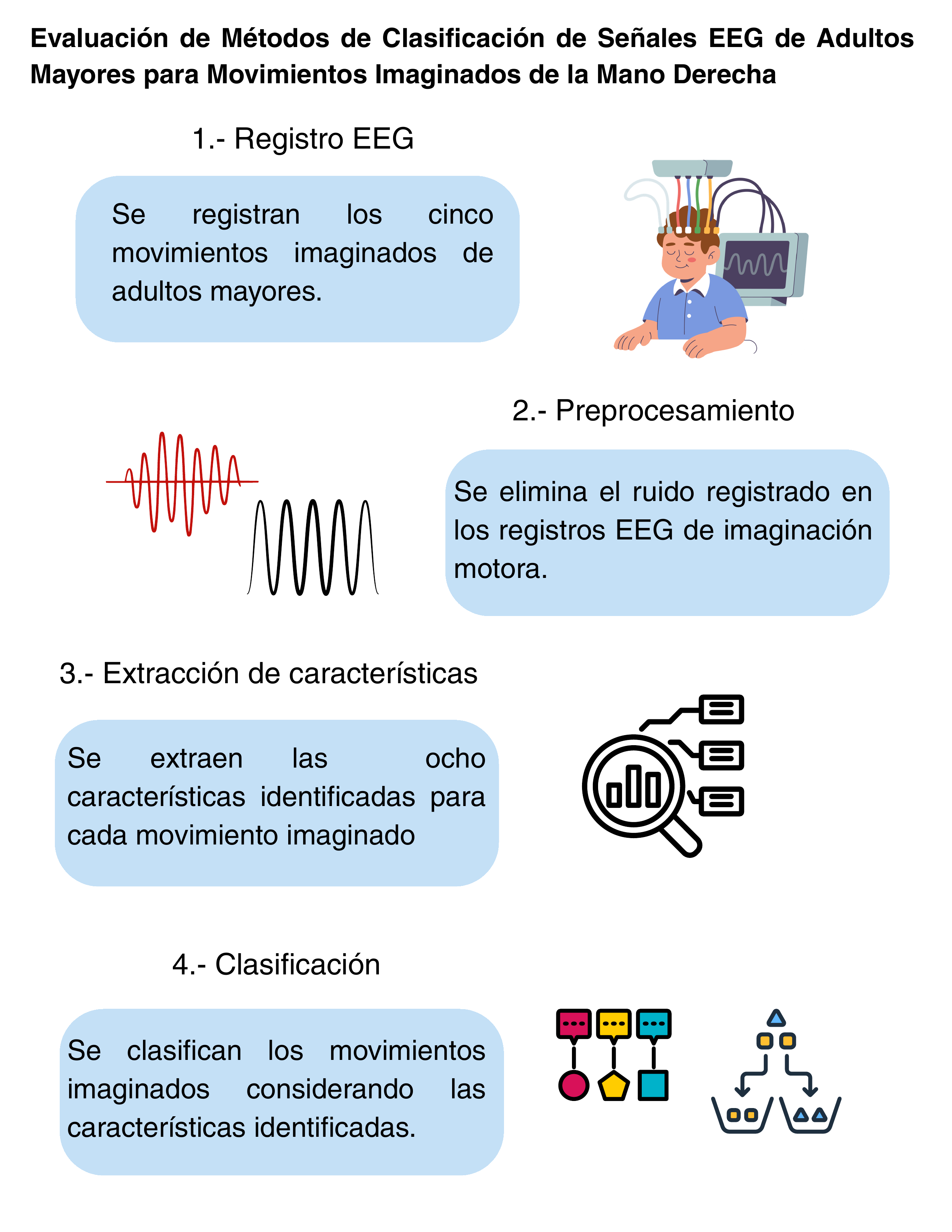
Cognitive decline, characterized by the progressive loss of functions such as memory, attention, and speech, significantly affects the well-being of older adults, a population that is growing rapidly worldwide. In response to this issue, brain-computer interfaces (BCIs) represent a promising technological alternative to facilitate interaction with digital devices, particularly for individuals experiencing reduced motor abilities. This study proposes a methodology for classifying five imagined right-hand movements in older adults using EEG signals. Exhaustive experimentation was conducted, evaluating eight distinct representational features extracted from the EEG data and applying various machine learning algorithms, including ensemble methods, to develop a computational model that achieved an accuracy of 93.7%. Additionally, subsets of features capable of maintaining classification accuracy above 90% were identified. These findings support the feasibility of integrating BCI solutions tailored to the needs of older adults in assistive and rehabilitation applications.
Downloads
References
DESA, «World Population Prospects 2024 Summary of Results», 2024, p. 1. [En línea]. Disponible en: https://population.un.org/wpp/assets/Files/WPP2024_Key-Messages.pdf (Consultado Marzo, 15, 2025)
United Nations Department for Economic and Social Affairs, World Population Prospects 2024: Summary of Results. S.l.: United Nations, 2025. [En línea]. Disponible en: https://population.un.org/wpp/assets/Files/WPP2024_Summary-of-Results.pdf (Consultado Marzo, 15, 2025)
K. Kim, S. S. Gollamudi, y S. Steinhubl, «Digital technology to enable aging in place», Exp. Gerontol., vol. 88, pp. 25-31, feb. 2017, doi: 10.1016/j.exger.2016.11.013.
M. F. H. López, «La situación demográfica en México. Panorama desde las proyecciones de población», 2013, [En línea].Disponible en: http://www.conapo.gob.mx/work/models/CONAPO/Resource/1720/1/images/1_La_Situacion_Demografica_En_Mexico.pdf (Consultado Marzo, 12, 2025)
T.-S. Lee et al., «A Brain-Computer Interface Based Cognitive Training System for Healthy Elderly: A Randomized Control Pilot Study for Usability and Preliminary Efficacy», PLoS ONE, vol. 8, n.o 11, p. e79419, nov. 2013, doi: 10.1371/journal.pone.0079419.
L. Mendes, J. Oliveira, F. Barbosa, y M. Castelo-Branco, «A Conceptual View of Cognitive Intervention in Older Adults With and Without Cognitive Decline—A Systemic Review», Front. Aging, vol. 3, p. 844725, mar. 2022, doi: 10.3389/fragi.2022.844725.
S. J. Oh, S. Seo, J. H. Lee, M. J. Song, y M.-S. Shin, «Effects of smartphone-based memory training for older adults with subjective memory complaints: a randomized controlled trial», Aging Ment. Health, vol. 22, n.o 4, pp. 526-534, abr. 2018, doi: 10.1080/13607863.2016.1274373.
B. Klimova y M. Valis, «Smartphone Applications Can Serve as Effective Cognitive Training Tools in Healthy Aging», Front. Aging Neurosci., vol. 9, p. 436, ene. 2018, doi: 10.3389/fnagi.2017.00436.
A. C. M. Bauer y G. Andringa, «The Potential of Immersive Virtual Reality for Cognitive Training in Elderly», Gerontology, vol. 66, n.o 6, pp. 614-623, 2020, doi: 10.1159/000509830.
P. Gamito et al., «Cognitive Stimulation of Elderly Individuals with Instrumental Virtual Reality-Based Activities of Daily Life: Pre-Post Treatment Study», Cyberpsychology Behav. Soc. Netw., vol. 22, n.o 1, pp. 69-75, ene. 2019, doi: 10.1089/cyber.2017.0679.
L. Lopez-Samaniego, B. Garcia-Zapirain, y A. Mendez-Zorrilla, «Memory and accurate processing brain rehabilitation for the elderly: LEGO robot and iPad case study», Biomed. Mater. Eng., vol. 24, n.o 6, pp. 3549-3556, nov. 2014, doi: 10.3233/BME-141181.
A. Palumbo, V. Gramigna, B. Calabrese, y N. Ielpo, «Motor-Imagery EEG-Based BCIs in Wheelchair Movement and Control: A Systematic Literature Review», Sensors, vol. 21, n.o 18, p. 6285, sep. 2021, doi: 10.3390/s21186285.
J. M. Toribio-Guzmán, E. Parra Vidales, M. a J. Viñas Rodríguez, Y. Bueno Aguado, M. a T. Cid Bartolomé, y M. A. Franco-Martín, «Rehabilitación cognitiva por ordenador en personas mayores: programa gradior», Aula, vol. 24, n.o 0, p. 61, jul. 2018, doi: 10.14201/aula2018246175.
V. Palumbo y F. Paterno, «Micogito: a Serious Gamebook Based on Daily Life Scenarios to Cognitively Stimulate Older Adults», en Proceedings of the Conference on Information Technology for Social Good, Roma Italy: ACM, sep. 2021, pp. 163-168. doi: 10.1145/3462203.3475889.
S. Kim, W. Yao, y X. Du, «Exploring Older Adults’ Adoption and Use of a Tablet Computer During COVID-19: Longitudinal Qualitative Study», JMIR Aging, vol. 5, n.o 1, p. e32957, mar. 2022, doi: 10.2196/32957.
E. Hargittai, A. M. Piper, y M. R. Morris, «From internet access to internet skills: digital inequality among older adults», Univers. Access Inf. Soc., vol. 18, n.o 4, pp. 881-890, nov. 2019, doi: 10.1007/s10209-018-0617-5.
S. J. Czaja y S. Z. Weingast, «The changing face of aging: Characteristics of older adult user groups», Gerontechnology, vol. 19, n.o 2, pp. 115-124, jul. 2020, doi: 10.4017/gt.2020.19.2.004.00.
K. Pai, R. Kallimani, S. Iyer, B. Uma Maheswari, R. Khanai, y D. Torse, «A Survey on Brain-Computer Interface and Related Applications», en Machine Intelligence for Internet of Medical Things: Applications and Future Trends, M. Ouaissa, M. Ouaissa, Z. Boulouad, I. Ullah Khan, y S. Iyer, Eds., Bentham Science Publishers, 2023, pp. 210-228. doi: 10.2174/9789815080445123020016.
K. Värbu, N. Muhammad, y Y. Muhammad, «Past, Present, and Future of EEG-Based BCI Applications», Sensors, vol. 22, n.o 9, p. 3331, abr. 2022, doi: 10.3390/s22093331.
R. Abiri, S. Borhani, E. W. Sellers, Y. Jiang, y X. Zhao, «A comprehensive review of EEG-based brain–computer interface paradigms», J. Neural Eng., vol. 16, n.o 1, p. 011001, feb. 2019, doi: 10.1088/1741-2552/aaf12e.
G. Li, C. H. Lee, J. J. Jung, Y. C. Youn, y D. Camacho, «Deep learning for EEG data analytics: A survey», Concurr. Comput. Pract. Exp., vol. 32, n.o 18, p. e5199, sep. 2020, doi: 10.1002/cpe.5199.
M. Bamdad, H. Zarshenas, y M. A. Auais, «Application of BCI systems in neurorehabilitation: a scoping review», Disabil. Rehabil. Assist. Technol., vol. 10, n.o 5, pp. 355-364, sep. 2015, doi: 10.3109/17483107.2014.961569.
J. Sabio, N. S. Williams, G. M. McArthur, y N. A. Badcock, «A scoping review on the use of consumer-grade EEG devices for research», PLOS ONE, vol. 19, n.o 3, p. e0291186, mar. 2024, doi: 10.1371/journal.pone.0291186.
L. Rizzo, P. Zicari, F. Cicirelli, A. Guerrieri, M. Micieli, y A. Vinci, «A Study on Consumer-Grade EEG Headsets in BCI Applications», en 2024 IEEE Conference on Pervasive and Intelligent Computing (PICom), Boracay Island, Philippines: IEEE, nov. 2024, pp. 67-74. doi: 10.1109/PICom64201.2024.00016.
W. Zhang, C. Tan, F. Sun, H. Wu, y B. Zhang, «A Review of EEG-Based Brain-Computer Interface Systems Design», Brain Sci. Adv., vol. 4, n.o 2, pp. 156-167, dic. 2018, doi: 10.26599/BSA.2018.9050010.
K. Haltas, A. Erguzen, y E. Erdal, «Classification methods in EEG based motor imagery BCI systems», en 2019 3rd International Symposium on Multidisciplinary Studies and Innovative Technologies (ISMSIT), Ankara, Turkey: IEEE, oct. 2019, pp. 1-5. doi: 10.1109/ISMSIT.2019.8932947.
H. Altaheri et al., «Deep learning techniques for classification of electroencephalogram (EEG) motor imagery (MI) signals: a review», Neural Comput. Appl., vol. 35, n.o 20, pp. 14681-14722, jul. 2023, doi: 10.1007/s00521-021-06352-5.
M. F. Saputra, N. A. Setiawan, y I. Ardiyanto, «Deep Learning Methods for EEG Signals Classification of Motor Imagery in BCI», IJITEE Int. J. Inf. Technol. Electr. Eng., vol. 3, n.o 3, p. 80, dic. 2019, doi: 10.22146/ijitee.48110.
A. Tyagi y V. Nehra, «Classification of motor imagery EEG signals using SVM, k-NN and ANN», CSI Trans. ICT, vol. 4, n.o 2-4, pp. 135-139, dic. 2016, doi: 10.1007/s40012-016-0091-2.
M. Y. Hossain y A. Sayeed, «A Comparative Study of Motor Imagery (MI) Detection in Electroencephalogram (EEG) Signals Using Different Classification Algorithms», en 2021 International Conference on Automation, Control and Mechatronics for Industry 4.0 (ACMI), Rajshahi, Bangladesh: IEEE, jul. 2021, pp. 1-6. doi: 10.1109/ACMI53878.2021.9528276.
J. Kevric y A. Subasi, «Comparison of signal decomposition methods in classification of EEG signals for motor-imagery BCI system», Biomed. Signal Process. Control, vol. 31, pp. 398-406, ene. 2017, doi: 10.1016/j.bspc.2016.09.007.
N. E. Md Isa, A. Amir, M. Z. Ilyas, y M. S. Razalli, «Motor imagery classification in Brain computer interface (BCI) based on EEG signal by using machine learning technique», Bull. Electr. Eng. Inform., vol. 8, n.o 1, pp. 269-275, mar. 2019, doi: 10.11591/eei.v8i1.1402.
H. Nisar, K. Wee Boon, Y. Kim Ho, y T. Shen Khang, «Brain-Computer Interface: Feature Extraction and Classification of Motor Imagery-Based Cognitive Tasks», en 2022 IEEE International Conference on Automatic Control and Intelligent Systems (I2CACIS), Shah Alam, Malaysia: IEEE, jun. 2022, pp. 42-47. doi: 10.1109/I2CACIS54679.2022.9815460.
N. Sharma et al., «Recent Trends in EEG-Based Motor Imagery Signal Analysis and Recognition: A Comprehensive Review», IEEE Access, vol. 11, pp. 80518-80542, 2023, doi: 10.1109/ACCESS.2023.3299497.
J. R. Wolpaw, J. D. R. Millán, y N. F. Ramsey, «Brain-computer interfaces: Definitions and principles», en Handbook of Clinical Neurology, vol. 168, Elsevier, 2020, pp. 15-23. doi: 10.1016/B978-0-444-63934-9.00002-0.
C. Rashmi y C. Sahntala, «EEG artifacts detection and removal techniques for brain computer interface applications: a systematic review», Int. J. Adv. Technol. Eng. Explor., vol. 9, n.o 88, 2021, doi: 10.19101/IJATEE.2021.874883.
D. D. Mondal y M. Alagirisamy, «A Detailed Study on IIR-FIR Filters and Design of a Graphical User Interface for Simulation of EEG Signals», Res. J. Comput. Syst. Eng., vol. 4, n.o 2, pp. 216-225, dic. 2023, doi: 10.52710/rjcse.89.
D. Bansal y R. Mahajan, «EEG-Based Brain-Computer Interfacing (BCI)», en EEG-Based Brain-Computer Interfaces, Elsevier, 2019, pp. 21-71. doi: 10.1016/B978-0-12-814687-3.00002-8.
P. D. E. Baniqued et al., «Brain–computer interface robotics for hand rehabilitation after stroke: a systematic review», J. NeuroEngineering Rehabil., vol. 18, n.o 1, p. 15, ene. 2021, doi: 10.1186/s12984-021-00820-8.
D. Marcos-Martínez, V. Martínez-Cagigal, E. Santamaría-Vázquez, S. Pérez-Velasco, y R. Hornero, «Neurofeedback Training Based on Motor Imagery Strategies Increases EEG Complexity in Elderly Population», Entropy, vol. 23, n.o 12, p. 1574, nov. 2021, doi: 10.3390/e23121574
Y. Miao et al., «BCI-Based Rehabilitation on the Stroke in Sequela Stage», Neural Plast., vol. 2020, pp. 1-10, dic. 2020, doi: 10.1155/2020/8882764.
Lobo A, Saz P, Marcos G, Día JL, de la Cámara C, Ventura T, Morales Asín F, Fernando Pascual L, Montañés JA, Aznar S. Revalidación y normalización del Mini-Examen Cognoscitivo (primera versión en castellano del Mini-Mental Status Examination) en la población general geriátrica [Revalidation and standardization of the cognition mini-exam (first Spanish version of the Mini-Mental Status Examination) in the general geriatric population]. Med Clin (Barc). 1999 Jun 5;112(20):767-74. Spanish. Erratum in: Med Clin (Barc) 1999 Jul 10;113(5):197. PMID: 10422057. [En línea] https://pubmed.ncbi.nlm.nih.gov/10422057/ Disponible en: https://www.researchgate.net/profile/Tirso-Faci/publication/232425808_Revalidacion_y_normalizacion_del_Mini-Exame n_Cognoscitivo_primera_version_en_castellano_del_Mini-Mental_Status_Examination_en_la_poblacion_general_geriatr ica/links/53ea354a0cf2dc24b3cb1491/Revalidacion-y-normalizacion-del-Mini-Examen-Cognoscitivo-primera-version-encastellano-del-Mini-Mental-Status-Examination-en-la-poblacion-general-geriatrica.pdf
Acharya JN, Hani A, Cheek J, Thirumala P, Tsuchida TN. American Clinical Neurophysiology Society Guideline 2: Guidelines for Standard Electrode Position Nomenclature. J Clin Neurophysiol. 2016 Aug;33(4):308-11. doi: 10.1097/WNP.0000000000000316. PMID: 27482794.
Downloads
Published
How to Cite
Issue
Section
License
Copyright (c) 2026 Revista Mexicana de Ingenieria Biomedica

This work is licensed under a Creative Commons Attribution-NonCommercial 4.0 International License.
Upon acceptance of an article in the RMIB, corresponding authors will be asked to fulfill and sign the copyright and the journal publishing agreement, which will allow the RMIB authorization to publish this document in any media without limitations and without any cost. Authors may reuse parts of the paper in other documents and reproduce part or all of it for their personal use as long as a bibliographic reference is made to the RMIB. However written permission of the Publisher is required for resale or distribution outside the corresponding author institution and for all other derivative works, including compilations and translations.