Predictive models of anthropometric parameters for primary screening of sarcopenia based on Machine Learning
DOI:
https://doi.org/10.17488/RMIB.47.2.1565Keywords:
Decisión trees, Elderly people, Machine Learning, Primary screening, SarcopeniaAbstract
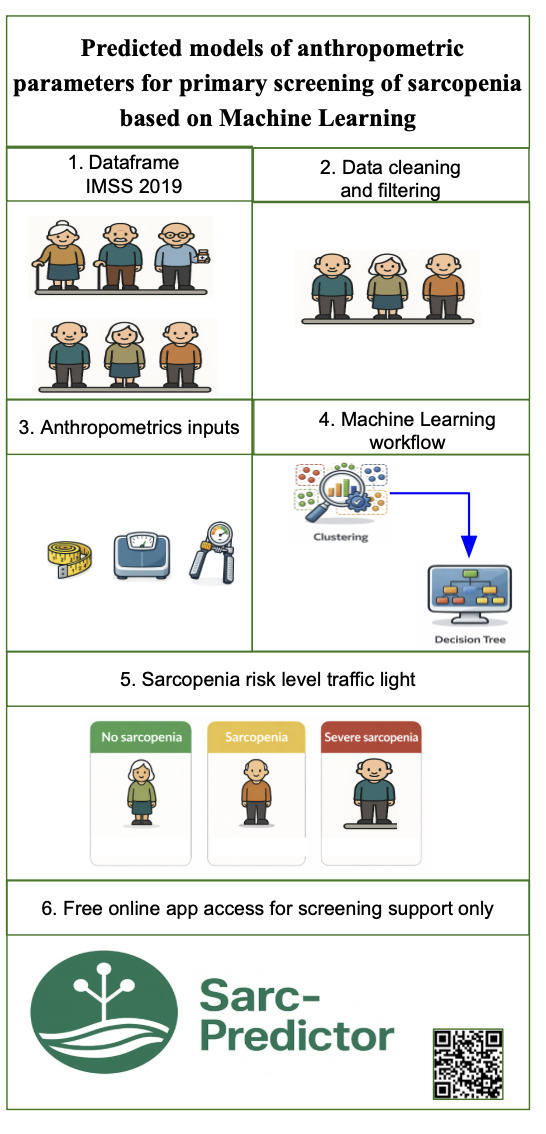
This work reports a free-access primary screening system for detecting sarcopenia risk in older Mexican adults, using machine learning and anthropometric variables obtained through accessible instruments such as measuring tapes. An observational, retrospective, and analytical study was conducted based on records from beneficiaries of the Mexican Social Security Institute from the year 2019, with a sample of 1,678 participants. The models, developed using data from individuals without comorbidities, followed a structured machine learning workflow that included data preprocessing, variable transformation and clustering, and supervised classification using decision-tree-based models. The optimal variable combinations for men and women achieved F1-scores above 0.94, accurately classifying the risk levels of sarcopenia and severe sarcopenia. The current models need to be expanded to include individuals with comorbidities such as type 2 diabetes, hypertension, and arthritis, which have been associated with greater muscle mass loss. This proposal does not replace clinical diagnostic testing but serves as a complementary tool to rule out low-risk individuals and prioritize specialized evaluation for those who may be affected by sarcopenia.
Downloads
References
Chen C, Liao DM. Mechanisms for the development of sarcopenia and its medical and nutritional prevention: A narrative review. Tungs’ Medical Journal, vol. 19, supl. 1, pp. S11–S15, 2025. https://doi.org/10.4103/etmj.etmj-d-25-00003
Aguilera Reguera D, Fuentes Díaz Z, Rodríguez Salazar O. Estimación de factores predictivos de la sarcopenia secundaria al cáncer en el paciente quirúrgico. Gaceta Médica Espirituana, vol. 26, s/p, 2024. Consulted November 2025. https://dialnet.unirioja.es/servlet/articulo?codigo=9972492
Cruz-Jentoft AJ, Bahat G, Bauer J, Boirie Y, Bruyère O, Cederholm T, Cooper C, Landi F, Rolland Y, Sayer AA, Schneider S M, Sieber CC, Topinkova E, Vandewoude M, Visser M, Zamboni M. Sarcopenia: revised European consensus on definition and diagnosis. Age and Ageing, vol. 48, no. 1, pp. 16–31, 2019. https://doi.org/10.1093/ageing/afy169
Cheng K, Chow S, Hung V, Wong C, Wong R, Tsang C, Cheung W. Diagnosis of Sarcopenia by evaluating Skeletal muscle mass by adjusted Bioimpedance analysis validated with Dual‐Energy X‐Ray Absorptiometry. Journal of Cachexia, Sarcopenia and Muscle, vol. 12, no. 6, pp. 2163–2173, 2021. https://doi.org/10.1002/jcsm.12825
Tseng Y, Mo S, Zeng Y, Zheng W, Song H, Zhong B, Luo F, Rong L, Liu J, Luo Z. Machine Learning Model in Predicting Sarcopenia in Crohn’s Disease Based on Simple Clinical and Anthropometric Measures. International Journal of Environmental Research and Public Health, vol. 20, no. 1, p. 656, 2023. https://doi.org/10.3390/ijerph20010656
Rocha A, Teixeira N, Santos A, Fonseca A, Rocha JS. Risk of Sarcopenia in Older People: Association with Illiteracy and Negative Self-Perception of Health. Revista Psicologia e Saúde, vol. 17, s/p, 2025. https://doi.org/10.20435/pssa.v1i1.2842
Gómez de la Garza M. Desarrollo y validación de una ecuación antropométrica para estimar la masa apendicular muscular utilizando como referencia la absorciometría dual de rayos x en adultos mayores. Universidad Autónoma de Nuevo León, tesis, 2013. Consulted November 2025. http://eprints.uanl.mx/11871/
Ramírez E, Enríquez-Reyna M, Garza-Sepúlveda G, Tijerina-Sáenz A, Ramos-Peña E, Gómez de la Garza M. Puntos de corte y validación de una ecuación antropométrica para estimar la masa muscular en población mexicana. Salud Pública de México, vol. 57, no. 6, pp. 485–486, 2015. Consulted November 2025. https://www.scielo.org.mx/scielo.php?script=sci_arttext&pid=S0036-36342015000600003
Javadpour N. Machine Learning Approaches Towards Cybersickness Prediction: An Updated Systematic Review. Iowa State University, Master thesis, 2024. https://doi.org/10.31274/td-20250502-278
Olshvang D, Harris C, Chellappa R, Santhanam P. Predictive modeling of lean body mass, appendicular lean mass, and appendicular skeletal muscle mass using machine learning techniques: A comprehensive analysis utilizing NHANES data and the Look AHEAD study. PLoS One, 19(9), e0309830. 2024. https://doi.org/10.1371/journal.pone.0309830
Charbuty B, Abdulazeez A. Classification based on decision tree algorithm for machine learning. Journal of Applied Science and Technology Trends, vol. 2, no. 1, pp. 20–28, 2021. https://doi.org/10.38094/jastt20165
Zhang S, Yang X, An N, Lv M, Yang L, Liu R, Hu S, Chen W, Feng W, Mao Y. Risk factors and predictive models for sarcopenia in older adults. Aging Medicine. 2025;8(3):192-199. https://doi.org/10.1002/agm2.70012
He X, Song Y, Ma L, Ainsworth BE, Liu Y, Chen N. Prevalence and factors influencing sarcopenia among community-dwelling older adults using the Asian Working Group for Sarcopenia Definition. Clinical Interventions in Aging, pp. 1707–1727, 2022. https://doi.org/10.2147/cia.s388319
Gómez Salazar L, Arango Hoyos G, Dueñas E, Reyes Ortíz C. Probabilidad de sarcopenia asociada a funcionalidad y riesgo de caídas en adultos mayores de Colombia. Retos, no. 63, pp. 63–73, 2025. https://doi.org/10.47197/retos.v63.100622
Arceo-Díaz S, Bricio-Barrios EE, Trujillo-Trujillo XAR, González-Farías JR, Bricio-Barrios JA, Ríos-Silva M, Huerta-Viera M. Sistema de Cribado Primario para la Sarcopenia en Personas Adultas Mayores Basado en Inteligencia Artificial. Revista Mexicana de Ingeniería Biomédica, vol. 44, no. SPE1, pp. 53–69, 2023. https://doi.org/10.17488/rmib.44.4.4
Brandao-Rangel M, Brill B, de Souza Carvalho E, Melamed D, Moraes-Ferreira R, Silva-Reis A, Leonardo P, Frison CR, De Angelis K, Vieira R. Physically Active Lifestyle Attenuates Impairments on Lung Function and Mechanics in Hypertensive Older Adults. Advances in Respiratory Medicine, vol. 92, no. 4, pp. 278–290, 2024. https://doi.org/10.3390/arm92040027
Lammie S, Rodríguez-Araña S, Posada Rodríguez C, Flores-Cuadra J, Pérez-Lao A, Britton GB, Oviedo DC, Tratner AE. A Cross-Sectional and Longitudinal Analysis of Cognitive Function and Well-Being of Older Adults in Panama During the COVID-19 Pandemic. COVID, vol. 5, p. 128, 2025. https://doi.org/10.3390/covid5080128
Instituto Mexicano del Seguro Social. Cuadernillo de Obesidad, Sarcopenia y Fragilidad en Adultos Mayores (OSFAMM). IMSS, México, 1ª ed., 2018.
Salinas-Rodríguez A, Rojas-Botero M, Rivera-Almaraz A, Fernández-Niño J, Montañez-Hernández J, Manrique-Espinoza B. Long-term inequalities in health among older Mexican adults: An outcome-wide analysis. SSM–Population Health, vol. 26, p. 101684, 2024. https://doi.org/10.1016/j.ssmph.2024.101684
López-Ortega M, Arroyo P. Anthropometric characteristics and body composition in Mexican older adults: age and sex differences. British Journal of Nutrition, vol. 115, no. 3, pp. 490–499, 2016. https://doi.org/10.1017/S0007114515004626
Ko JB, Kim KB, Shin,Y. S, Han H, Han S. K, Jung D. Y, Hong, JS. Predicting sarcopenia of female elderly from physical activity performance measurement using machine learning classifiers. Clinical Interventions in Aging, 1723-1733.2021. 2021. https://doi.org/10.2147/CIA.S323761
MacEwan JP, Gill TM, Johnson K, Sullivan J, Shim J, Goldman DP. Measuring sarcopenia severity in older adults and the value of effective interventions. The journal of nutrition, health & aging, 22(10), 1253-1258. 2018. https://doi.org/10.1007/s12603-018-1104-7
Shasaif M, Shaik A. Enhancements in Random Forest Algorithms for Improving Healthcare Applications. In Proceedings of the International Conference on Industrial Engineering and Operations Management; IEOM Society International: Southfield, MI, USA. 2024. https://doi.org/10.46254/IN04.20240192
Silveira P, Vieira, J, Siqueira J. Is the Bland-Altman plot method useful without inferences for accuracy, precision, and agreement? Revista de Saúde Pública, 58, 01. 2024. https://doi.org/10.11606/s1518-8787.2024058005430
Arceo-Díaz S, Bricio-Barrios EE, González-Farías JR, De la Madrid-Trevizo L, Trujillo-Trujillo XAR, Bricio-Barrios JA, Huerta-Viera M. Sistema Biomédico Basado en Inteligencia Artificial para Estimar Indirectamente Sarcopenia en Personas Adultas Mayores Mexicanas. Revista ELECTRO, vol. 46, no. 1, pp. 18–24, 2024. Available at: https://itchihuahua.mx/revista_electro/2024/A53_18-24.html
Fritz M, Beutel A, et al. LOG-Means: Efficiently Estimating the Number of Clusters in Large Datasets. Proceedings of the VLDB Endowment, 2020.
https://doi.org/10.14778/3407790.3407813
Arteaga-Zambrano A, Solorzano-Veliz S, Castro-Jalca J. Comorbilidades asociadas a diabetes mellitus en población adulta. Conocimiento Global, vol. 9, supl. 1, pp. 234–244, 2024. Available at: https://conocimientoglobal.org/revista/index.php/cglobal/article/view/544
Güleryüz D, Efe F, Efe B. Estimation of Anthropometric Measurements Using Optimized Machine Learning Models with Bayesia Algorithm. Scientia Iranica, s/p, 2023. https://doi.org/10.24200/sci.2023.61224.7209
Park M, Kim Y, Lee J. Machine Learning-Based Model for Grip Strength Prediction in Healthy Adults: A Nationwide Dataset-Based Study. Journal of Clinical Medicine, vol. 14, no. 5, p. 1542, 2025. https://doi.org/10.3390/jcm14051542
Seto H, Oyama A, Kitora S, Toki H, Yamamoto R, Kotoku J, Haga A, Shinzawa M, Yamakawa M, Fukui S, Moriyama T. Gradient boosting decision tree becomes more reliable than logistic regression in predicting probability for diabetes with big data. Scientific Reports. 2022;12:15889. https://doi.org/10.1038/s41598-022-20149-z
Turimov-Mustapoevich D, Kim W. Machine learning applications in sarcopenia detection and management: a comprehensive survey. In Healthcare (Vol. 11, No. 18, p. 2483). MDPI. 2023. https://doi.org/10.3390/healthcare11182483
Castillo-Olea C, García-Zapirain A, Soto B, Carballo Lozano C, Zuñiga C. Automatic classification of sarcopenia level in older adults: a case study at Tijuana General Hospital. International Journal of Environmental Research and Public Health, 16(18), 3275. 2019. https://doi.org/10.3390/ijerph16183275
Salinas-Rodríguez A, Palazuelos-González R, Rivera-Almaraz A, Manrique-Espinoza B. Longitudinal association of sarcopenia and mild cognitive impairment among older Mexican adults. J Cachexia Sarcopenia Muscle. 2021 Dec;12(6):1848-1859. https://doi.org/10.1002/jcsm.12787
Yuan S, Larsson S. Epidemiology of sarcopenia: Prevalence, risk factors, and consequences. Metabolism, 144, 155533. 2023. https://doi.org/10.1016/j.metabol.2023.155533
Kim S, Kim H, Yoo J. Sarcopenia classification model for musculoskeletal patients using smart insole and artificial intelligence gait analysis. Journal of Cachexia, Sarcopenia and Muscle, vol. 14, no. 6, pp. 2793–2803, 2023. https://doi.org/10.1002/jcsm.13356
Friedman JH. Greedy function approximation: a gradient boosting machine. Ann Stat. 2001;29(5):1189–1232. https://doi.org/10.1214/aos/1013203451
Wen Y, Wan Z, Ren H, Wang X, Wang W. Interpretable Machine Learning Model for Predicting and Assessing the Risk of Diabetic Nephropathy. JMIR Medical Informatics, vol. 13, e64979, 2025. https://doi.org/10.2196/64979
Kim J, Jeong K, Lee S, et al. Machine-learning model predicting quality of life using multifaceted lifestyles in middle-aged South Korean adults: a cross-sectional study. BMC Public Health, vol. 24, p. 159, 2024. https://doi.org/10.1186/s12889-023-17457-y
Yáñez-Sepúlveda, R., Vásquez-Bonilla, A., Olivares, R. et al. Supervised machine learning algorithms for the classification of obesity levels using anthropometric indices derived from bioelectrical impedance analysis. Scientific Reports, vol. 15, p. 30681, 2025. https://doi.org/10.1038/s41598-025-15264-6
Karimov S, Turimov D, Kim W, Kim J. Comparative study of imputation strategies to improve the sarcopenia prediction task. Digital Health, vol. 11, 20552076241301960. 2025. https://doi.org/10.1177/20552076241301960
Sepúlveda Loyola W, Luna Corrales G, Ganz F, González-Caro H, Suziane Probst V. Sarcopenia, definición y diagnóstico: ¿Necesitamos valores de referencia para adultos mayores de Latinoamérica? Revista Chilena de Terapia Ocupacional, vol. 20, no. 2, pp. 259–267, 2020. https://doi.org/10.5354/0719-5346.2020.53583
Blanquet M, Massoulié G, Boirie Y, Guiguet-Auclair C, Mulliez A, Anker S, Eschalier R, et al. Handgrip strength to screen early‑onset sarcopenia in heart failure. Clinical Nutrition ESPEN, vol. 50, pp. 183–190, 2022. https://doi.org/10.1016/j.clnesp.2022.05.019
Published
How to Cite
Issue
Section
License
Copyright (c) 2026 Revista Mexicana de Ingenieria Biomedica

This work is licensed under a Creative Commons Attribution-NonCommercial 4.0 International License.
Upon acceptance of an article in the RMIB, corresponding authors will be asked to fulfill and sign the copyright and the journal publishing agreement, which will allow the RMIB authorization to publish this document in any media without limitations and without any cost. Authors may reuse parts of the paper in other documents and reproduce part or all of it for their personal use as long as a bibliographic reference is made to the RMIB. However written permission of the Publisher is required for resale or distribution outside the corresponding author institution and for all other derivative works, including compilations and translations.