Explorando el impacto de la propiocepción artificial en la estabilidad postural en individuos con prótesis transtibiales
DOI:
https://doi.org/10.17488/RMIB.46.3.1494Palabras clave:
Propiocepción artificial, estabilidad postural, prótesis transtibiales, retroalimentación sensorial, control del equilibrioResumen
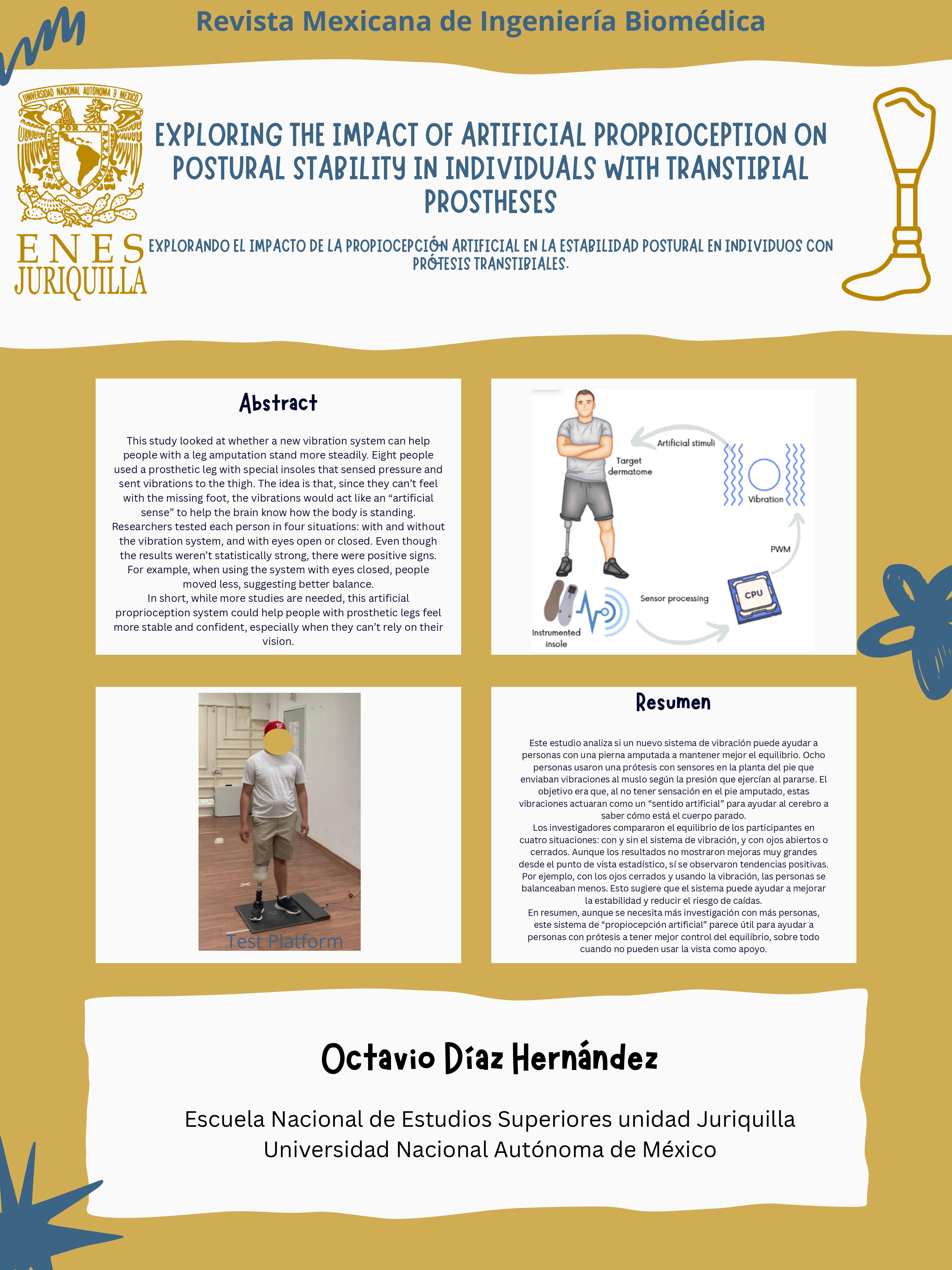
Este estudio analiza el impacto de la Propiocepción Artificial (PA) en la estabilidad postural de usuarios de prótesis transtibiales. Ocho amputados transtibiales participaron en un ensayo clínico con un dispositivo de PA compuesto por plantillas instrumentadas y actuadores vibratorios. La estabilidad postural se evaluó en cuatro condiciones: ojos abiertos/cerrados, con y sin PA. Se analizaron métricas estabilométricas como las dinámicas del Centro de Presión (COP) e índices de Romberg. La PA mejoró significativamente la estabilidad, especialmente con ojos cerrados. Los índices de Romberg para el área de balanceo y la distancia del COP disminuyeron en un 32.8% y 19.5%, respectivamente. La variabilidad en las métricas del COP reflejó una adaptación a la nueva retroalimentación sensorial, permitiendo estrategias de equilibrio más refinadas. Aunque el tamaño reducido de la muestra limita la generalización, los hallazgos resaltan el potencial de la PA para mejorar el equilibrio, reducir el riesgo de caídas y optimizar la rehabilitación. El estudio introduce un mecanismo novedoso para compensar déficits propioceptivos. La PA mejora significativamente la estabilidad postural al potenciar la retroalimentación sensorial. Investigaciones futuras deben evaluar sus impactos a largo plazo y aplicaciones funcionales.
Descargas
Citas
I. Fagioli et al., “Advancements and Challenges in the Development of Robotic Lower Limb Prostheses: a Systematic Review,” IEEE Trans Med Robot Bionics, 2024, doi: 10.1109/TMRB.2024.3464126.
J. N. Mello, M. R. Garcia, A. C. P. R. da Costa, and A. B. Soares, “Towards optimum amplitude and frequency of electrotactile stimulation in amputee for effective somatotopic sensory feedback,” Research on Biomedical Engineering, vol. 41, no. 1, pp. 1–16, Mar. 2025, doi: 10.1007/S42600-024-00385-0/TABLES/7.
A. Demofonti et al., “Restoring somatotopic sensory feedback in lower limb amputees through non-invasive nerve stimulation,” Cyborg and Bionic Systems, Feb. 2025, doi: 10.34133/CBSYSTEMS.0243.
R. Valette, S. Manz, J. Gonzalez-Vargas, and S. Dosen, “Intuitive omnidirectional vibrotactile feedback from a sensorized insole for lower limb prostheses users,” Oct. 07, 2024, Authorea. doi: 10.36227/techrxiv.172833629.91719237/v1.
M. N. Kalff et al., “Impact of Gait-Synchronized Vibrotactile Sensory Feedback on Gait in Lower Limb Amputees,” Applied Sciences 2024, Vol. 14, Page 11247, vol. 14, no. 23, p. 11247, Dec. 2024, doi: 10.3390/APP142311247.
J. M. Canton Leal, J. V. Gyllinsky, A. A. Arredondo Zamudio, and K. Mankodiya, “HapticLink: A Force-based Haptic Feedback System for Single and Double Lower-Limb Amputees,” in 2022 44th Annual International Conference of the IEEE Engineering in Medicine & Biology Society (EMBC), IEEE, Jul. 2022, pp. 4226–4229. doi: 10.1109/EMBC48229.2022.9871460.
C. Basla, L. Chee, G. Valle, and S. Raspopovic, “A non-invasive wearable sensory leg neuroprosthesis: Mechanical, electrical and functional validation,” J Neural Eng, vol. 19, no. 1, p. 016008, Feb. 2022, doi: 10.1088/1741-2552/ac43f8.
F. C. G. Di Zubiena, L. D’Alvia, Z. Del Prete, and E. Palermo, “A static characterization of stretchable 3D-printed strain sensor for restoring proprioception in amputees,” in FLEPS 2022 - IEEE International Conference on Flexible and Printable Sensors and Systems, Proceedings, Institute of Electrical and Electronics Engineers Inc., 2022. doi: 10.1109/FLEPS53764.2022.9781497.
F. C. G. Di Zubiena et al., “FEM deformation analysis of a transtibial prosthesis fed with gait analysis data: A preliminary step towards restoring proprioception in amputees,” in 2021 IEEE International Workshop on Metrology for Industry 4.0 and IoT, MetroInd 4.0 and IoT 2021 - Proceedings, Institute of Electrical and Electronics Engineers Inc., 2021, pp. 493–498. doi: 10.1109/MetroInd4.0IoT51437.2021.9488482.
A. Gardetto et al., “Reduction of phantom limb pain and improved proprioception through a tsr‐based surgical technique: A case series of four patients with lower limb amputation,” J Clin Med, vol. 10, no. 17, Sep. 2021, doi: 10.3390/JCM10174029.
F. M. Petrini et al., “Enhancing functional abilities and cognitive integration of the lower limb prosthesis,” Sci Transl Med, vol. 11, no. 512, Oct. 2019, doi: 10.1126/scitranslmed.aav8939.
G. Valle, G. Preatoni, and S. Raspopovic, “Connecting residual nervous system and prosthetic legs for sensorimotor and cognitive rehabilitation,” in Somatosensory Feedback for Neuroprosthetics, Elsevier, 2021, pp. 293–320. doi: 10.1016/B978-0-12-822828-9.00007-1.
R. A. Coker, E. R. Zellmer, and D. W. Moran, “Micro-channel sieve electrode for concurrent bidirectional peripheral nerve interface. Part B: Stimulation,” J Neural Eng, vol. 16, no. 2, 2019, doi: 10.1088/1741-2552/AAEFAB.
B. P. Christie, E. L. Graczyk, H. Charkhkar, D. J. Tyler, and R. J. Triolo, “Visuotactile synchrony of stimulation-induced sensation and natural somatosensation,” J Neural Eng, vol. 16, no. 3, p. 036025, Jun. 2019, doi: 10.1088/1741-2552/ab154c.
L. Yang, P. S. Dyer, R. J. Carson, J. B. Webster, K. Bo Foreman, and S. J. M. Bamberg, “Utilization of a lower extremity ambulatory feedback system to reduce gait asymmetry in transtibial amputation gait,” Gait Posture, vol. 36, no. 3, pp. 631–634, Jul. 2012, doi: 10.1016/j.gaitpost.2012.04.004.
F. Barberi, E. Anselmino, A. Mazzoni, M. Goldfarb, and S. Micera, “Toward the Development of User-Centered Neurointegrated Lower Limb Prostheses,” IEEE Rev Biomed Eng, vol. 17, pp. 212–228, 2024, doi: 10.1109/RBME.2023.3309328.
A. Ghiami Rad and B. Shahbazi, “A systematic investigation of sensorimotor mechanisms with intelligent prostheses in patients with ankle amputation while walking,” J Mech Behav Biomed Mater, vol. 151, p. 106357, Mar. 2024, doi: 10.1016/j.jmbbm.2023.106357.
S. Raspopovic, G. Valle, and F. M. Petrini, “Sensory feedback for limb prostheses in amputees,” Nat Mater, vol. 20, no. 7, pp. 925–939, Jul. 2021, doi: 10.1038/s41563-021-00966-9.
G. Preatoni, G. Valle, F. M. Petrini, and S. Raspopovic, “Lightening the Perceived Prosthesis Weight with Neural Embodiment Promoted by Sensory Feedback,” Current Biology, vol. 31, no. 5, pp. 1065-1071.e4, Mar. 2021, doi: 10.1016/j.cub.2020.11.069.
F. C. G. Di Zubiena, M. Paolucci, L. D’alvia, Z. Del Prete, and E. Palermo, “A 3-D-Printed Elastomeric Strain Sensor With Mechanical and Thermal Characterization for Restoring Proprioception in Lower Limb Amputees,” IEEE Trans Instrum Meas, vol. 73, 2024, doi: 10.1109/TIM.2024.3436116.
L. Chee, G. Valle, G. Preatoni, C. Basla, M. Marazzi, and S. Raspopovic, “Cognitive benefits of using non-invasive compared to implantable neural feedback,” Sci Rep, vol. 12, no. 1, p. 16696, Oct. 2022, doi: 10.1038/s41598-022-21057-y.
O. Diaz-Hernandez, I. Salinas-Sanchez, A. Santos-Borraez, and S. Vargas-Vidal, “Device for Artificial Proprioception Applied to Lower Limb Prosthesis,” in XLVII Mexican Conference on Biomedical Engineering, B. and R.-L. J. J. and H. A. H. Y. and A. L. G. and Z.-A. E. and D. H.-G. E. and S.-R. R. A. Flores Cuautle José de Jesús Agustín and Benítez-Mata, Ed., Cham: Springer Nature Switzerland, 2025, pp. 79–88. doi: 10.1007/978-3-031-82126-4_8.
O. Diaz-Hernandez and I. Salinas-Sanchez, “Towards Artificial Proprioception in Prosthetic Devices,” International Journal of Medical Science, vol. 10, no. 1, pp. 1–5, Feb. 2023, doi: 10.14445/23939117/IJMS-V10I1P101.
J. L. Taylor, “Proprioception,” Encyclopedia of Neuroscience, pp. 1143–1149, Jan. 2009, doi: 10.1016/B978-008045046-9.01907-0.
F. Tjernström, M. Björklund, and E. M. Malmström, “Romberg ratio in quiet stance posturography—Test to retest reliability,” Gait Posture, vol. 42, no. 1, pp. 27–31, Jun. 2015, doi: 10.1016/J.GAITPOST.2014.12.007.
T. Paolucci et al., “Romberg ratio coefficient in quiet stance and postural control in Parkinson’s disease,” Neurol Sci, vol. 39, no. 8, pp. 1355–1360, Aug. 2018, doi: 10.1007/S10072-018-3423-1.
A. Field, Discovering statistics using IBM SPSS statistics, vol. 58. 2013.
Descargas
Publicado
Cómo citar
Número
Sección
Licencia
Derechos de autor 2025 Revista Mexicana de Ingenieria Biomedica

Esta obra está bajo una licencia internacional Creative Commons Atribución-NoComercial 4.0.
Una vez que el artículo es aceptado para su publicación en la RMIB, se les solicitará al autor principal o de correspondencia que revisen y firman las cartas de cesión de derechos correspondientes para llevar a cabo la autorización para la publicación del artículo. En dicho documento se autoriza a la RMIB a publicar, en cualquier medio sin limitaciones y sin ningún costo. Los autores pueden reutilizar partes del artículo en otros documentos y reproducir parte o la totalidad para su uso personal siempre que se haga referencia bibliográfica al RMIB. No obstante, todo tipo de publicación fuera de las publicaciones académicas del autor correspondiente o para otro tipo de trabajos derivados y publicados necesitaran de un permiso escrito de la RMIB.